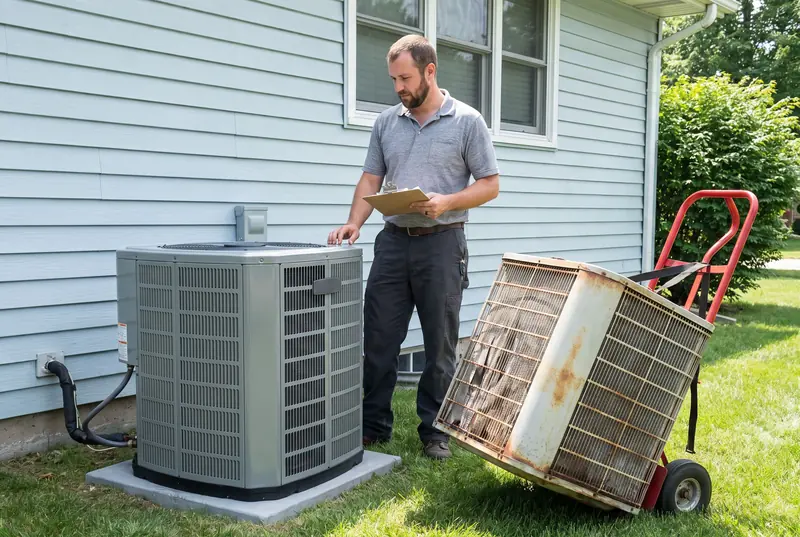
There comes a point when keeping an old system running costs more than replacing it, and finding that point takes honest arithmetic rather than a sales pitch. For most homes in Pleasanton, CA, the clues cluster: rising amp draw on a tired compressor, a heat exchanger flagged at inspection, refrigerant that keeps disappearing from an R-22 or early R-410A system, and bills that grow as comfort shrinks. When a major repair lands on equipment past the twelve-to-fifteen-year mark, it is usually a stopgap on technology that already trails current SEER2 and AFUE standards.
Most of our service calls are for AC Repair and Furnace Repair. That's the place to start if you need a fix today.
Warning Signs for HVAC Replacement
Spotting the early warning signs lets you act before the problem gets expensive. These are the signals our technicians see most often:
- Corrosion and soot marks growing on the equipment
- An R-22 system, or one that loses refrigerant faster than recharges can justify
- Clanking, buzzing, or roaring every time the system cycles
- Utility costs creeping up every season while your habits stay the same
- Comfort complaints the old system never resolves: hot rooms, cold floors, sticky air
- A failed compressor or cracked heat exchanger, the repairs that tip the decision
- An aging system, twelve to fifteen years or more, with problems piling up
- Repair bills stacking up faster, each larger than the one before
Act Before It Gets Worse
What seems like a minor issue today can take out a compressor or heat exchanger tomorrow. At the first hint of a problem, call (925) 205-6534 for a fast inspection.